

Museo Manzetti
Associazione culturale
1987-2026
39 anni di attività
sede associazione
e piccolo museo-collezione (privato):
Viale Federico Chabod, 62
11100 Aosta (Valle d'Aosta)
museo.manzetti@gmail.com
Tel. 339 3574718
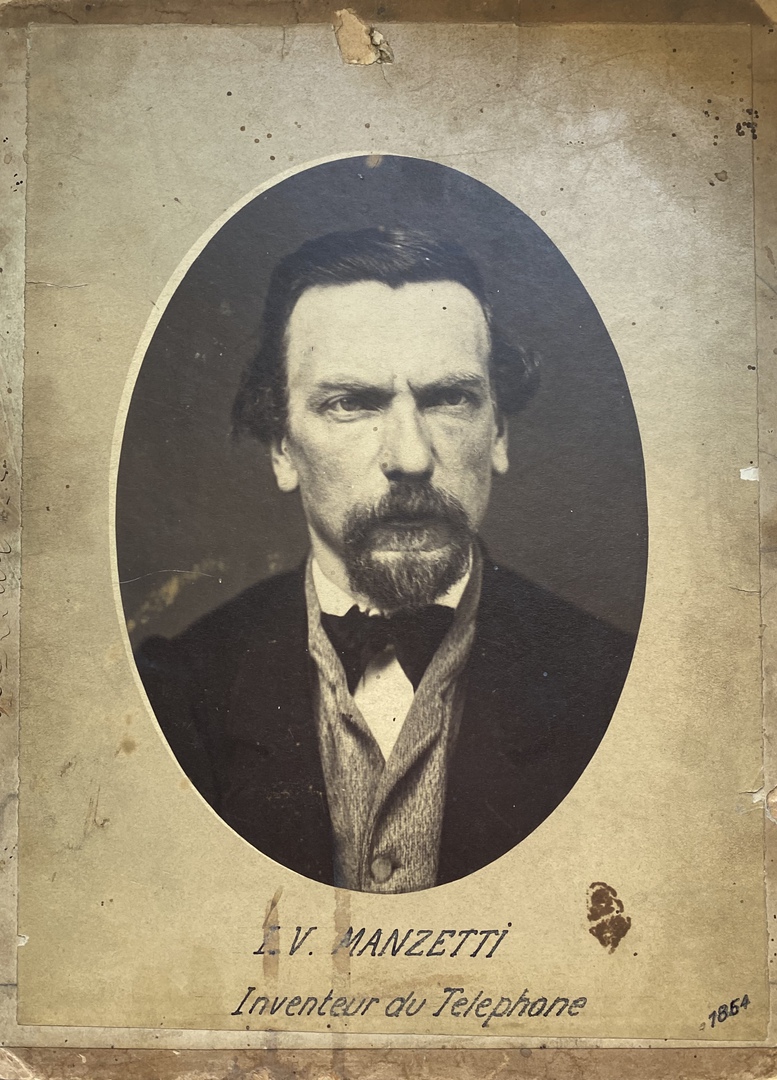
Innocenzo Manzetti
The Inventor from Aosta
and the Forgotten History of the Telephone
Innocenzo Manzetti was born in Aosta on 17 March 1826.
From an early age, he showed a particular interest in mechanics and physics. After qualifying as a surveyor, he pursued his professional career alongside his research and inventions throughout his life.
In 1840, while still a teenager, he built an automaton capable of playing the flute, which he also attempted to make reproduce the human voice. In the autumn of 1849, Captain Laurent Pléod, passing beneath the windows of Manzetti’s home, heard sounds resembling the human voice, though not quite the same. Invited upstairs, he discovered the flute-playing automaton and described the episode in an almanac published in December of that year. In 1884, a newspaper also recalled the existence of a document written by Manzetti in 1849, now lost, concerning the transmission of sounds by means of electricity.
In the following years, Manzetti patented a machine for making pasta at home and designed mechanical instruments, hydraulic pumps, buildings and public works. In 1864, he also built a steam-powered road vehicle, which could run on other fuels as well and was capable of travelling independently through the streets of Aosta.
On 29 June 1865, the newspaper «L’Indépendant» announced that Manzetti had developed a device capable of transmitting the human voice over a distance through an electrical wire. It was the «vocal telegraph», which the press was already calling a telephone a few months later. The news spread through Italian and foreign newspapers, eventually reaching the United States.
In New York, Antonio Meucci learned of the invention through «L’Eco d’Italia» and wrote to the newspaper, claiming that he had conceived a similar system many years earlier. Nevertheless, he acknowledged: «I cannot deny Mr Manzetti his invention», even proposing that they combine their respective ideas.
Meucci claimed to have conducted telephone experiments as early as 1849, but most of the testimonies concerning those early experiments emerged many years later and contain several contradictions. In 1865, he described a system involving a metal plate held between the teeth, used in connection with his electrotherapy experiments. On 12 December 1871, he established the «Telettrofono Company» with several partners, under an agreement providing for further experiments to develop the invention. Sixteen days later, he filed a caveat, a preliminary declaration concerning his «Sound Telegraph», in which the metal plate still featured. The document was renewed over the following two years but never developed into a telephone patent.
Alexander Graham Bell, by contrast, filed his patent application on 14 February 1876 and was granted the patent on 7 March. He subsequently contributed to the development and commercialisation of the telephone, which soon began to spread rapidly.
Manzetti died in Aosta on 15 March 1877, just two days before his fifty-first birthday, without having patented his telephone apparatus. His death, however, did not bring the story to an end.
On 4 November 1879, Bell wrote to the naturalist Samuel Hubbard Scudder, asking him to locate seven newspapers from 1865 and 1866 that had reported on Manzetti’s telephone invention. Ninety-four days later, on 7 February 1880, Horace Hamline Eldred, an American businessman initially associated with Bell’s circle, was in Aosta to acquire the rights to Manzetti’s telephone and telegraph inventions, in an operation that also involved Max Meyer. A telephone prototype and several of the inventor’s manuscripts were acquired.
The affair took on the characteristics of a story of industrial espionage. Eldred returned to the United States and, as early as April 1880, signed a technical specification with George Freeland Durant concerning a telephone communication system, followed by further patent applications. Had he drawn inspiration from Manzetti’s designs? The documentation currently available does not allow this to be fully established.
Eldred continued to work in the telephone industry in both America and Europe.
In 1885, August Mathias Tanner, a patent attorney in Washington, also sought to gather testimonies concerning the experiments of the inventor from the Aosta Valley, whose name thus continued to circulate among those involved in disputes over the origins of the telephone.
Manzetti’s memory remained alive mainly in Aosta, while the international history of telephony increasingly focused on Meucci and Bell. Research conducted over recent decades has brought to light newspapers, letters and documents that now make it possible to recognise Manzetti’s documentary precedence in the electrical transmission of speech, with published accounts dating back to 1865, six years before Meucci’s caveat and eleven years before Bell’s patent.
Two centuries after his birth, Manzetti is also commemorated at the Manzetti Museum, housed in the Saint-Bénin Centre in Aosta, while ongoing research continues to reveal new chapters in a story that crossed the Atlantic.
 Stampa
Mappa del sito
© Innocenzo Manzetti - Museo Manzetti (associazione culturale) Sede: Viale Federico Chabod, 62 - 11100 Aosta (Valle d'Aosta, Italia, EU) -------- Sito Ufficiale/Site Officiel/Official Site -------- La Sala Museale, invece, è di proprietà della Regione valdostana e si trova sita presso il centro Saint-Bénin al 27 di via Festaz in Aosta.